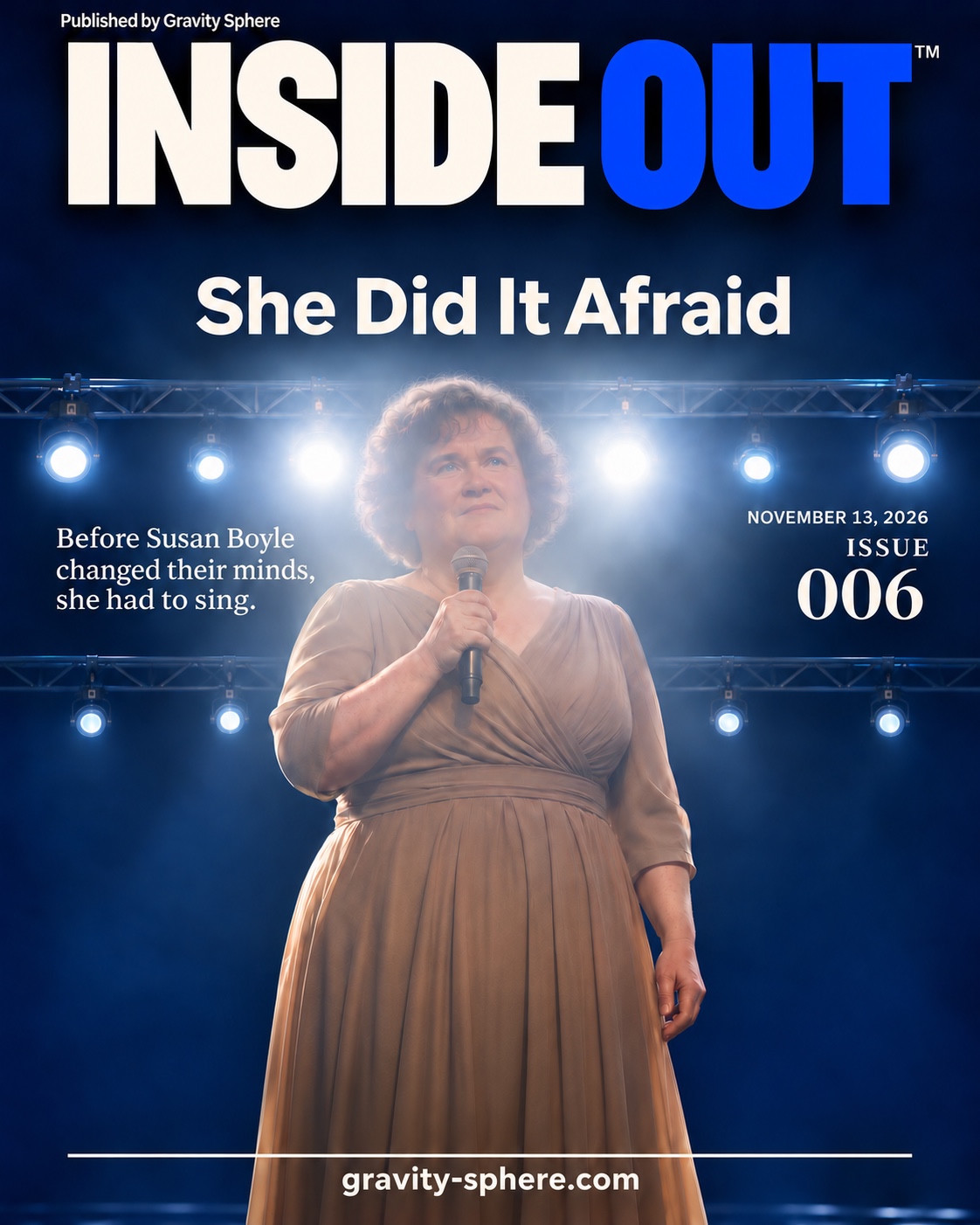
There is a moment before the first note when the room has already begun to decide.
It has a face to look at. An age to consider. A voice speaking rather than singing. Enough information to form an impression, and nowhere near enough to know a person.
Then Susan Boyle sings.
The surprise in that audition is familiar now. We know what comes next. We can watch with the comfortable certainty of people who have already seen the ending. But she could not stand on that stage with our knowledge. She had to walk into the moment before it became the moment everyone remembered.
In an interview shortly afterward, she said she had been nervous and wanted to do well. The performance that stunned the audience had begun with the ordinary fear of someone hoping to be given a chance. [1]
That is where this story begins for us. Before the applause. Before a recording contract. Before the world knew her name.
With a person who still had to try.
Boyle was 47 when her Britain's Got Talent audition introduced her to an enormous audience in 2009. She sang “I Dreamed a Dream.” The response transformed a televised audition into an international introduction. [1]
But her talent had not changed between walking onto the stage and singing the first note.
What changed was the evidence available to the people watching. They could finally hear what they had not been able to judge by looking. The voice interrupted the story they were beginning to tell themselves about the woman who possessed it.
That is why the moment reaches beyond music. Many people know what it means to enter a room with something to offer and wonder whether anyone will give them time to demonstrate it. A person can be capable long before a particular audience recognizes the capability. Recognition is an event in someone else's understanding. It is not the date your worth begins.
There is responsibility on both sides of that encounter. The person with something to offer needs opportunities to make it visible. The people making judgments need the patience to examine what is actually being offered.
The burden cannot belong entirely to the person being underestimated.
Watching the audition, it is easy to congratulate ourselves for loving the voice. The more uncomfortable question is whether we would have made room for the person before we heard it.
Before the world knew her name
The phrase “overnight success” tells us when the public arrived. It tells us very little about how long someone had been there.
Boyle had performed years before the audition that made her famous. Contemporary reporting described footage of her singing as a young woman, an earlier attempt to reach television through a 1995 audition, and subsequent lessons with voice coach Fred O'Neil. That earlier television attempt had not brought her the breakthrough she wanted. [2]
These details matter because they return the years to the story.
Without them, we are left with a comforting illusion: a gifted person appears, sings once, and is discovered. There is no awkward beginning. No earlier attempt that fails to become a career. No stretch of time in which the person must decide whether the effort is still worth making.
The real account asks more of us. It asks us to make room for the person who was trying before the world knew her name.
Perhaps that is also why this story can hurt a little. Some readers are living in those years now. They have work nobody asks to see. Applications that never become conversations. A skill that the people around them appreciate but that has not yet opened a door. They can recognize another person's breakthrough while privately wondering whether their own will ever arrive.
We should not answer that ache with an easy promise. Not every attempt produces recognition. A closed door does not always conceal a lesson, and a person does not have to turn every disappointment into something beautiful immediately.
Sometimes it is simply disappointing.
But an unsuccessful attempt is not a complete assessment of a life. It tells you what happened on that occasion. The danger comes when the outcome becomes an identity: this did not work becomes I am someone for whom nothing will work.
There is a great deal of living between those two statements. There is still room for another teacher, another approach, another audience, another opportunity to be heard.
Belief can ask for help
Boyle confirmed in her 2009 interview with Larry King that she had taken singing lessons. [3] Her voice was a gift, but having a gift did not make guidance unnecessary.
There is a useful kind of self-belief that can say both things at once: I have something worth developing, and I do not know everything about how to develop it.
A coach brings another set of trained ears. Someone who can hear the habit you no longer notice, recognize the strain you have learned to work around, or help you reach something you cannot yet reach consistently. That is part of what it means to work on a blind spot. You allow another person to notice what is difficult to notice from inside your own performance.
Seeking that help does not diminish the talent. It gives the talent somewhere to grow.
We often make confidence sound like a refusal to doubt anything. But confidence that cannot accept correction becomes fragile. It has to defend every mistake. A more durable confidence can listen, practice, and return without interpreting each adjustment as proof that it never belonged.
For anyone preparing for a difficult conversation, a presentation, an audition, or a new role, that distinction matters. You can believe in your ability and still rehearse. You can have experience and still need feedback. You can be good at the work and still need help making the work understood.
Practice is one way belief becomes something you can act on.
A dream with someone missing
The story also carried grief. Boyle told Harper's Bazaar that her mother, who had encouraged her singing, died in 2007. She connected the audition song to that loss and described wanting to do the performance for her mother. [4]
That gives the stage a different weight.
An audience can see a contestant. It cannot see every person the contestant carries into the room. It cannot know which encouragement has survived in memory, which absence makes an achievement painful, or whose voice a person wishes they could hear afterward.
For readers who have lost someone who believed in them, the tension needs little explanation. You can want to move forward and wish you could take somebody with you. You can be grateful for an opportunity and ache because the person who would have loved it is not there.
Success does not settle every part of a life. Sometimes the brightest moment contains a private absence.
That is another reason to be careful with the word “finally.” Finally discovered. Finally successful. Finally happy. It closes a story that the person still has to live.
The anchor holds
There is no promise tucked inside an unsuccessful audition. No assurance that another attempt will repay the effort. There is only the decision about what to do next, made with less certainty than we would like.
This is where faith and belief can become an anchor.
The way forward can be anchored in faith, even while fear and uncertainty remain. The anchor does not make the water still. It holds while the water moves.
For one reader, that faith is rooted in God. For another, it is the conviction that their work deserves a serious attempt, even when the result is not yet visible. The conviction does not control the outcome. It can sustain the next act of preparation, the next request for guidance, the next decision to show up.
You do not need to feel fearless to do something courageous. If you waited until nothing could embarrass you, disappoint you, or expose a weakness, you might never step forward at all.
That does not mean ignoring your limits or repeating an approach that harms you. Persistence can change shape. Sometimes it means resting. Sometimes it means learning. Sometimes it means taking your work to people who are better able to understand it.
What matters is that an earlier judgment does not become the only voice you are willing to believe.
The audience sees the performance. The person performing must also live with the uncertainty that came before it. To appreciate the first without respecting the second is to miss much of the courage.
More than the result
Boyle did not win Britain's Got Talent. She finished runner-up. Later that year, her debut album reached number one in the United States, with 701,000 first-week sales. [5]
Even the famous breakthrough was not a straight line from audition to competition victory. The result of one contest did not contain the whole future.
We can learn from that without turning her life into a formula. There is no fixed number of setbacks that purchases a success. No rule that says a certain amount of pain earns a standing ovation. Her achievement is not evidence that everyone who remains unheard has failed to work hard enough.
It is evidence that the first impression can be incomplete. That preparation can precede recognition by years. That a nervous person can still deliver something extraordinary.
And it leaves us with two invitations.
If you are the person waiting to be heard, keep making room for your own development. Let someone help you. Look honestly at what needs work without surrendering everything that is already good. An audience that did not recognize your value is not the only audience that exists.
If you are the person doing the listening, allow the performance to arrive before your verdict does. People should not have to astonish us to receive our attention or respect.
The applause is the part we replay. The more useful part may be the moment before it, when nothing had been settled and Susan Boyle still had a song to sing.
She did not have to become fearless first.
She did it afraid.
See how your value comes across when you step forward.
Cover artwork is a conceptual editorial illustration, not a photograph of the audition.