Have you ever told the truth and discovered that someone else’s image was more convincing?
Have you ever been the person who found a familiar, reassuring explanation easier to believe?
On the day Tyler Shultz quit his job at Theranos, he invited a colleague to dinner at his grandfather’s house. Erika Cheung had been trying to get somebody at the company to take her concerns about its blood tests seriously. Tyler couldn’t promise that his grandfather would do anything. He thought he could promise that he would listen.
It was a reasonable thing for a grandson to believe. George Shultz, the former secretary of state, sat on the Theranos board. He was also the person who had introduced Tyler to Elizabeth Holmes in the first place. Whatever else had gone wrong at work, this was still his grandfather’s table.
Tyler had been a biology student when he met Holmes. A finger prick instead of a needle in the arm. A little blood giving a doctor answers that ordinarily took much more. Tyler wanted to help build that future, and he asked Holmes for an internship. He eventually went to work for Theranos full time.
Remember that part when you picture the dinner. There had been a time when grandfather and grandson could look at the same woman and see the same promise.
Then Tyler went to work in the laboratory. Much of the testing depended on machines other companies had made. When he raised that with George, his grandfather already had an explanation from Holmes about why those machines were there. Tyler was describing what he had seen at work. George was passing along what someone he trusted had told him. To the person listening, both can sound like knowledge.
Two witnesses at dinner
Cheung could speak for herself. She had handled patient samples. According to the account ABC News pieced together from interviews and Tyler’s deposition, the two young employees explained their concerns. George told them the devices were being used in medical evacuation helicopters. They were struggling to make the equipment work inside the company. How could it be working in a helicopter?
Imagine the question from George’s side of the table. A friend tells you her invention is already helping people in an emergency. Then two young people tell you something that would mean your friend has misled you. One of those accounts lets you go on trusting someone you have welcomed into your family. The other changes what you owe everyone you have reassured.
We can’t know what George thought over dinner. We do know what Tyler did. Even after his grandfather had told him he was wrong, he brought another person there to be heard. There is still a kind of faith in an invitation like that.
Back in the living room
When a Wall Street Journal reporter got in touch, Tyler let the message sit for about a month. Eventually he bought a phone with cash and called. He became one of several sources who helped John Carreyrou establish what was happening inside Theranos.
In an account he later gave at Columbia Business School, Tyler described meeting Theranos lawyers in his grandfather’s living room. They wanted him to sign papers, including a statement denying that he had talked to the press. His parents warned him that paying for his defense might mean selling their home.
It’s the change in the meaning of the room that stays with me. Once, a visit to his grandfather’s home had given him the chance to meet somebody extraordinary. Now he needed legal advice about what had happened there.
In 2022, a federal jury convicted Holmes on charges involving fraud against investors. She is serving her sentence in Texas. Tyler told NPR that his wife had texted him the verdict. His family opened champagne.
George had died by then. Before he died, he told Tyler that he had done the right thing. Tyler also said his grandfather never apologized.
Those are two different things a person can need to hear. One recognizes what you did. The other recognizes what it cost you when I wouldn’t believe you.
It’s easy to read this story from Tyler’s chair. Most of us can name someone we once needed to believe us. Try the other chair for a moment. Think of a person who brought you a concern about somebody you admire. Do you remember what they told you? Or do you mostly remember the reassuring thing you said back?
If their name came to mind, you may still have time to invite them back.
Reporting: ABC News on Cheung and Shultz, Shultz at Columbia, his interview with NPR, and the case outcome.
See how you come across when you speak up.
Would You Have Stopped?
By Lance Clarke
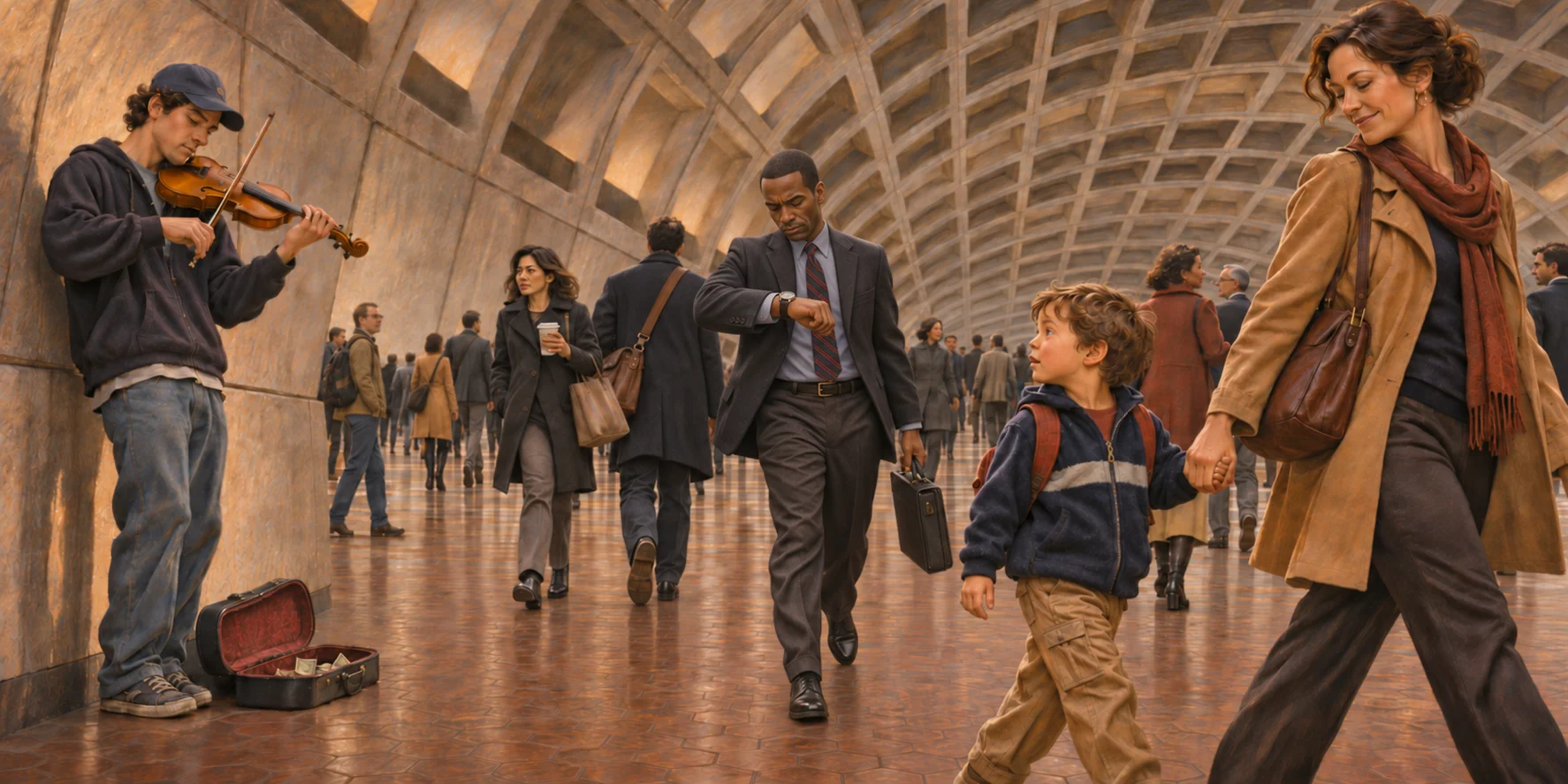
Evan wanted to watch the violinist. His mother had somewhere to take him. He kept looking back as they went.
From the violinist’s end of the station, that little boy would have looked much like everybody else. He was leaving.
It was a January morning in 2007. The Washington Post had arranged for Joshua Bell to play at L’Enfant Plaza in Washington during the rush to work. People bought tickets to hear this man play. Here, you could have him for the price of a few minutes, provided the minutes were yours to give.
I keep coming back to Evan because it would be so easy to count him wrong. If you were watching the doors, you would mark down two people who went through. If you were watching his face, you would have a story about a boy who wanted to stay.
His mother’s morning
It helps to remember what you brought into the station with you just now. I told you the musician’s name. I told you a newspaper thought this performance worth arranging. You arrived at that paragraph with one thing to do. Pay attention to the violinist.
Give the mother the same courtesy. Let her enter the story with a morning of her own. Anyone who has taken a small child somewhere on time knows how many things along the way deserve a closer look. A dog. A truck unloading. A man playing music. Sometimes you stop. Sometimes you have already stopped twice and somebody at the other end is waiting for you. Which kind of morning was she having? How much of it could a stranger see?
Years later, in an interview with the Jewish Standard, Bell spoke about what happens before a concert. An audience has already made a series of choices by the time he begins to play. Think how early listening can start. You choose a date. You ask someone to go with you. On the night itself you find your seats, and when the lights change you put away the conversation you were having. The violinist in a station gets none of that preparation. He has to find a place in a day that is already underway.
Run the morning twice
Try a small simulation with me. Picture a station from above. An adult and a child take a path past a musician. Freeze the picture at the door. If I ask whether the music made them change course, you can answer quite confidently. You have their whole path in front of you.
Now I ask whether the music mattered to either of them. What in that overhead picture could possibly tell you?
Run the same few seconds again, this time from the child’s height. Keep the pace, the route and the music exactly the same. Let us see his face turn back. His path through the station hasn’t changed an inch. Yet you might give a different answer about what he heard. From above, you could follow him all the way to the door and still miss the moment he looked back.
Think of the last time you tried to tell someone something that mattered to you and they glanced toward the door. You probably remember how it felt. You may even remember the sentence you decided to leave out. Suppose, weeks later, that person brought up something you said that day, in enough detail that you knew they had been listening. What would you give to go back and finish the sentence?
On the other end of the bow
There is a second performance worth putting beside the first. In 2014 Bell played at Washington’s Union Station. This time people knew he was coming. A crowd gathered. For at least some of those listeners, hearing him was the reason they were in the building.
It would be lovely to call that a second chance for everyone who walked past him the first time. It was a different station, a different day and a different audience. What the two mornings give us is a way to think about an invitation. Once people know whom they are about to hear, they can make room for the experience. On an ordinary morning, recognition has to happen while their feet are moving.
Most of us have spent a little time at both ends of that station. You have walked past something because a person you loved was counting on you to get somewhere. You have also put care into something, looked up and seen people already on their way out. From where you stood, it could feel as though the work had meant nothing to anybody.
Somewhere in that second picture there might have been an Evan. If you had watched only the door, how would you ever know?
Reporting: Gene Weingarten’s original Washington Post account, Bell’s interview with the Jewish Standard, and the Post’s reporting from Union Station. The two camera angles are an imagined replay of the reported encounter.
How is your influence landing with others? See your free preview.